

 简体中文
简体中文 にほんご
にほんご Deutsch
News Release
The influence mechanism and application selection of oil on rubber materials
In engineering practice, the compatibility between rubber materials and oil directly affects the performance and lifespan of components. Essentially, the mechanism of oil on rubber can be analyzed from three aspects:
Firstly, there is the swelling effect. When rubber comes into contact with oil, oil molecules gradually penetrate and diffuse between the rubber polymer chains, resulting in rubber volume expansion and a decrease in modulus. Next is the extraction process. Oil will dissolve and extract plasticizers and some low molecular weight additives from rubber, which may cause rubber to harden or become brittle over time. Finally, there is the issue of chemical compatibility. Some polar oils or oils containing active additives may undergo chemical reactions with the main chain or cross-linking structure of rubber molecules, thereby altering their properties.
In engineering, the oil resistance of rubber is usually comprehensively evaluated by measuring indicators such as volume change rate, mass change rate, hardness change, and tensile performance retention rate after soaking in oil. Generally speaking, a volume swelling rate within 10% is considered to have good oil resistance, while 10% -20% is acceptable. If it exceeds 30%, it is no longer suitable for most practical working conditions.
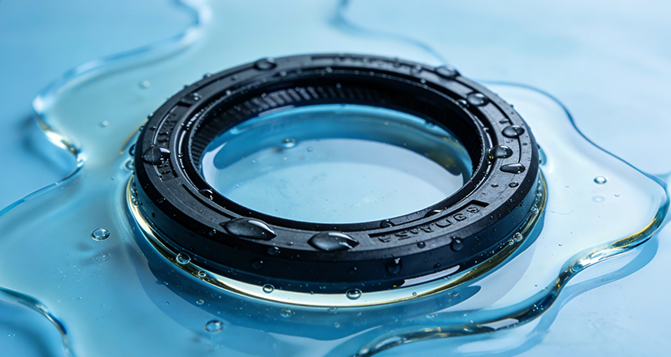
The following will analyze and provide suggestions for the selection of rubber materials for different oil systems.
1、 Mineral oil system (hydraulic oil, lubricating oil, engine oil)
Traditional mineral oil is mainly composed of petroleum fractions, mainly saturated alkanes, containing a certain proportion of aromatic hydrocarbons, and overall low polarity. Mineral oils from different standards or sources may have significant differences in their aromatic hydrocarbon content.
Recommended rubber material:
Nitrile rubber (NBR) is the most commonly used rubber material in this system, and its oil resistance mainly depends on the acrylonitrile content. Low nitrile NBR with acrylonitrile content of 18% -25% has good cold resistance but average oil resistance; Nitrile NBR with acrylonitrile content of 26% -34% has a relatively balanced comprehensive performance and is widely used; High nitrile NBR with acrylonitrile content of 35% -45% has excellent oil resistance, but its low-temperature elasticity may decrease. In mineral hydraulic oil at 40 ℃ -100 ℃, the volume expansion rate of medium high nitrile NBR can usually be controlled within 5% -15%.
Hydrogenated nitrile rubber (HNBR) significantly improves heat resistance, oxidation resistance, and fatigue resistance while maintaining good oil resistance of NBR. It is suitable for high-temperature hydraulic systems or engine oil environments and can be used for a long time at temperatures up to 150 ℃.
Fluororubber (FKM) performs exceptionally well in high-temperature, high load mineral oil systems, with a volume swelling rate typically below 5%, but at a high cost, and is often used in applications that require strict sealing performance.
2、 Fuel oil system (gasoline, diesel, aviation fuel)
Fuel oil contains a large amount of aromatic hydrocarbons and light components, which have strong swelling ability for rubber and usually have a certain degree of volatility.
Recommended rubber material:
Fluororubber (FKM) is a preferred choice for dealing with fuel environments such as gasoline and diesel, especially suitable for aromatic gasoline or high-temperature fuel systems. Its volume change rate can generally be maintained within 8%, and it can maintain good mechanical properties.
Acrylic rubber (ACM) has good resistance to mineral oil and diesel, with better heat resistance than NBR. However, its resistance to gasoline and low molecular weight aromatic hydrocarbons is average, making it more suitable for diesel and automatic transmission oil environments.
Epoxy chloropropane rubber (ECO/CO) has good stability towards fuel oil and gasoline vapor, as well as a certain degree of ozone resistance. It is commonly used in hoses and seals of automotive fuel systems.
3、 Synthetic oil system
PAO synthetic oil
The polarity of poly (alpha olefin) synthetic oil is low, and its swelling behavior is similar to that of high-purity mineral oil. Nitrile NBR, HNBR, and FKM are all applicable, and in general, nitrile NBR can meet the usage requirements.
Ester synthetic oil
Esters such as diesters and polyesters have higher polarity and significantly enhance their swelling effect on rubber. NBR swells more severely in this type of oil, and the volume change may exceed 30%, so it is not recommended to use it. More suitable materials include FKM, partially silicone rubber (VMQ), and ethylene acrylic rubber (AEM).
silicone oil
Silicone oil causes significant swelling in most organic rubbers. The material with the best compatibility is silicone rubber (VMQ), and fluororubber (FKM) can also be used as an alternative, but it needs to be verified in practice. It is generally not recommended to use NBR or EPDM rubber.
4、 Bio oil and environmentally friendly oil system
Bio oil is mainly derived from vegetable oil or its modified products, and contains a large number of polar groups in its molecules. NBR、 Styrene butadiene rubber (SBR) has poor tolerance in this type of oil. Fluororubber (FKM), ethylene acrylic rubber (AEM), and some thermoplastic polyurethanes (TPU) are better choices. Special attention should be paid to the fact that bio oil systems are often accompanied by high temperatures and oxidation conditions, which require higher aging resistance of rubber.
5、 Processing oil and high aromatic oil environment
In scenarios where rubber components come into contact with each other or equipment seals, it is sometimes necessary to consider the impact of processing oil migration. High aromatic oil has a significant swelling effect on NBR, natural rubber (NR), and other materials; Fluororubber (FKM), chlorosulfonated polyethylene rubber (CSM), and epichlorohydrin rubber (CO) have relatively better tolerance to aromatic oils. If there is a long-term soaking situation, low swelling material systems should be prioritized or the anti swelling ability should be improved by increasing the cross-linking density of rubber.
6、 Summary of Engineering Selection Experience
When selecting, the specific standards and components of the oil should be clearly defined, avoiding using general terms such as "hydraulic oil" and "lubricating oil" as the basis.
Even for the same type of rubber, the performance differences caused by different formulations may be much greater than the differences in the material types themselves.
The increase in temperature will significantly exacerbate the swelling and aging effects of oil on rubber, and the selection must consider the working temperature range.
For critical sealing components, it is recommended to conduct immersion verification tests using actual oil products at actual operating temperatures to obtain more reliable performance data.